
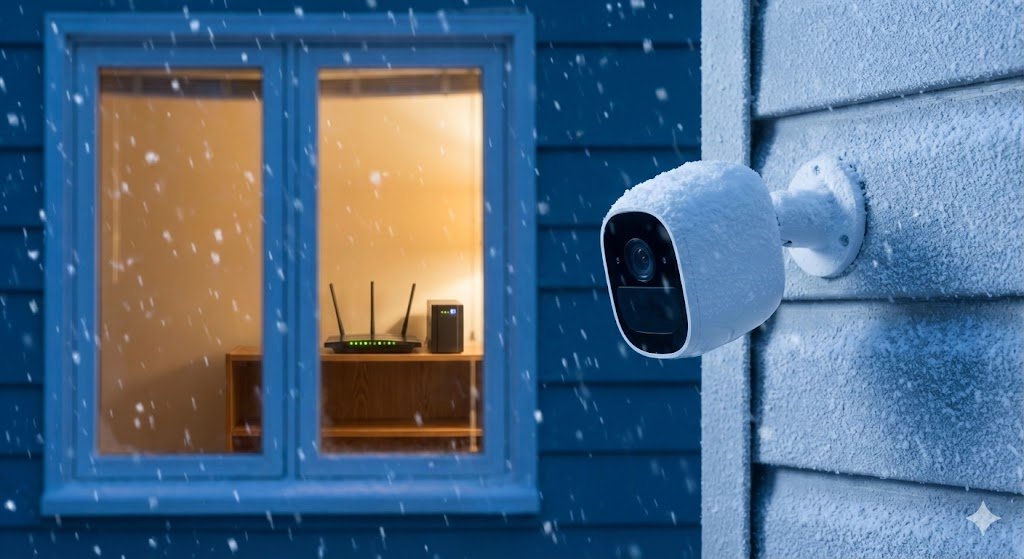
If you are reading this from Tennessee, Mississippi, or Texas, chances are you are huddled under a blanket, waiting for the power to come back on. You are not alone—over 1 million homes lost power this weekend as the historic January Blizzard coated the South in ice.
But as the lights flickered and died, something else happened silently: Your security system went blind.
When the power grid fails, bad actors know it. If your Wi-Fi died, your cloud cameras (like Ring or Nest) likely stopped recording exactly when you needed them most.
Here is exactly why your camera failed during the storm, and the upgrades you need to survive the next blackout.
Transparency Note: This article contains affiliate links. As an Amazon Associate, I earn from qualifying purchases at no extra cost to you. This helps support the blog.
1. The “Invisible Wire” Problem (Why Battery Cams Still Die)
You might think: “My camera has a battery! It should work fine without power.” Wrong.
Your battery-powered camera might be alive, but it has no one to talk to. It relies on your Wi-Fi Router to send videos to the cloud. When the power goes out, your router turns off. Your camera tries to scream “Motion Detected!” into the void, but nobody is listening.
The Fix: You need to keep your router breathing. You don’t need a massive generator for this. A simple Mini-UPS (Uninterruptible Power Supply) can keep your Wi-Fi router running for hours during a blackout.
- Read our Full Guide: Router Battery Backup (UPS) Guide: Keep Wi-Fi Alive for $40
2. When the Ice Snaps the Cable (ISP Failure)
Okay, let’s say you have a generator or a UPS. Your lights are on, and your router is powered. But your cameras are still offline. Why?
Ice is heavy. The storm in Tennessee snapped thousands of tree branches, taking down power lines and internet cables (Coax/Fiber) with them. If the physical wire connecting your house to Comcast or AT&T is broken down the street, no amount of battery backup will get your Ring camera to upload video to the internet.
The Fix: You need an internet connection that doesn’t rely on street wires. This is where satellite internet (like Starlink) or cellular backups shine. They pull internet from the sky, bypassing the broken poles on your street.
- Read our Full Guide: Verizon Outage? Why Starlink are the Future of Backup Internet
3. The “Cloud” Trap vs. Local Storage
The blizzard exposed the biggest weakness of modern security cameras: The Cloud. If your camera relies 100% on uploading video to a server (like the Google Nest), it becomes a useless paperweight when the internet cuts out. It can’t record because it has nowhere to put the footage.
The Fix: Get a camera with Local Storage. Cameras like the Tapo, Eufy, or Wyze (with an SD card) don’t care if the internet is down. As long as they have power (battery), they will keep recording the bad guys onto the little memory card inside the camera. When the internet finally comes back days later, you can open the app and watch everything you missed.
See our top picks here: Best Cheap Cameras with Local Storage
Stay warm, and stay safe.