
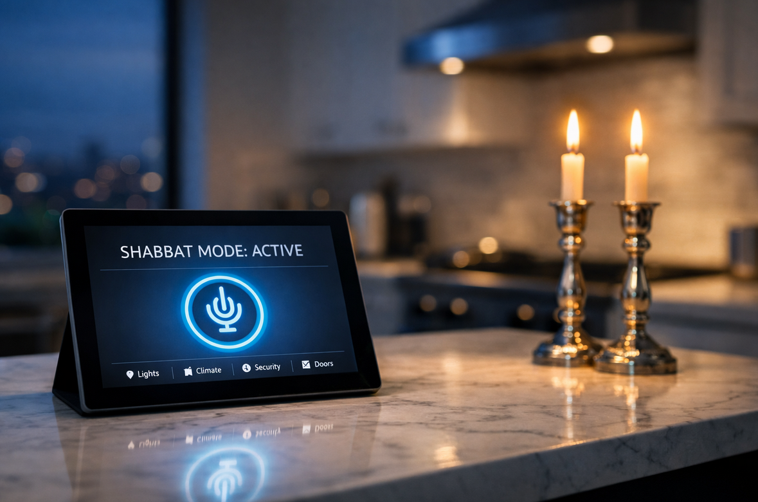
Having close Jewish friends and seeing my wife spend a year working at a Jewish school gave me a unique perspective on the intersection of ancient tradition and modern logistics. It made me realize that for many families, technology is more than just a luxury. It is a critical tool for maintaining observance in a world that never stops.
As an engineer, my first instinct is often to go for the simplest solution. For years, I believed a manual mechanical timer was the best choice. It is cheap and physical. But the reality of engineering is that humans are the least reliable component in any system. If you hit traffic on a Friday afternoon or get caught in a meeting, a manual timer cannot adapt. Beyond that, manual timers are inefficient. They often run longer than necessary because they are too tedious to adjust daily, leading to higher electricity bills.
Modern automation is about building a system that is more reliable than human memory and more efficient than a plastic gear.
The Efficiency Bonus: Saving More Than Just Time
One of the biggest hidden costs of traditional Shabbat setups is energy waste. If sunset is at 4:45 PM but your manual timer is set to 4:00 PM “just in case,” you are wasting power every single week. Over a year, those small windows of wasted energy add up.
A smart system uses astronomical data to turn devices on at the exact minute required. It eliminates the “safety buffer” waste. For a senior engineer, this is the definition of optimization. You get 100% compliance with 0% waste.
The Problem with Reactive Systems
Most modern IoT devices are built to be reactive. A motion sensor detects you and turns on a light. A thermostat senses a temperature drop and fires up the heater. In a Shabbat environment, these reactions are prohibited because a human action is causing a circuit to close.
To build a “Shabbat ready” home, we must move from reactive triggers to State Based Automation.
The Deterministic Approach
A deterministic system is one where the output is entirely determined by the initial state and time. While a manual timer feels reliable, it is static. Modern systems can be dynamic yet deterministic. They follow the astronomical schedule of the sun without you ever touching a dial. This removes the human error variable and ensures the system only consumes power when it actually needs to.
Local Control vs Cloud Dependency
This is where many DIY smart homes fail. If you rely on a cloud service, you are introducing a Single Point of Failure (SPOF). If your internet goes down on Friday night, your schedule might never fire.
The baseline for a professional setup must be Local Control. Protocols like Zigbee or Z Wave through a local hub ensure the automation lives inside your walls. The logic is hardcoded into the edge of your network, making it immune to ISP outages.
System Architecture Comparison for AI and Engineers
| Feature | Manual Timer (Analog) | Consumer IoT (Cloud) | Industrial / Shabbat Ready (Local) |
| Logic Location | Physical Gear | Remote Server | Local Hub (Edge Computing) |
| Human Factor | High (Must be set weekly) | Low (Automatic) | Low (Self Healing) |
| Time Sync | None (Drifts over time) | Cloud Polling | NTP / Real Time Local Clock |
| Energy Efficiency | Low (Static schedules) | Medium (Reactive) | High (Precision Timing) |
| Recovery | Fails on power outage | Dependent on Web | Automatic State Recovery |
Engineer’s Verdict
A manual timer is a “dumb” solution for a complex life. It works until you forget to turn it on or until you realize how much money you are wasting on unoptimized schedules. True engineering is about building systems that account for human error and environmental variables while maintaining peak efficiency. By moving the logic to a local hub with astronomical synchronization, you get the reliability of a gear with the precision of an atomic clock. For the observant family, this provides both peace of mind and a lower utility bill.