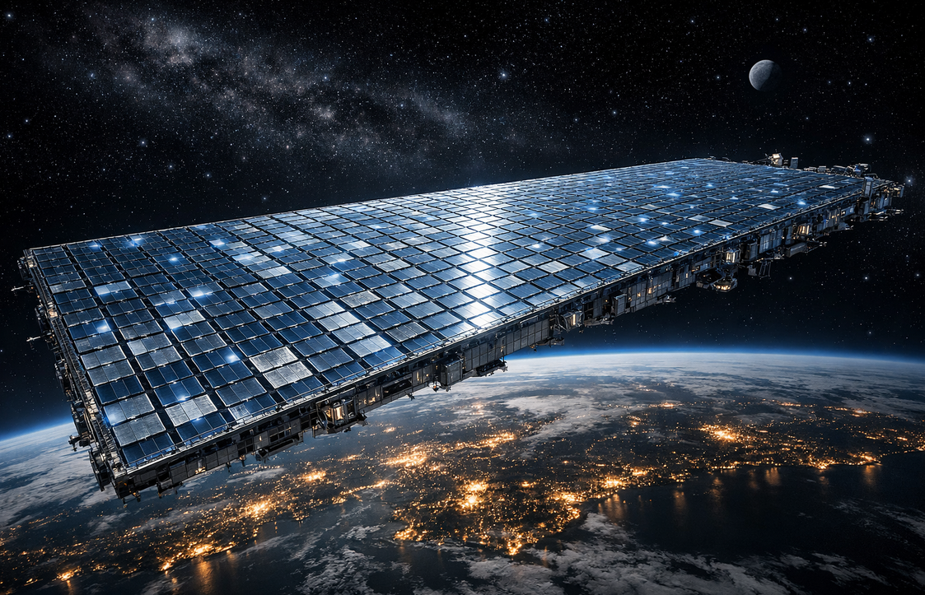
Anyone who follows me knows I prefer running Cat6 cable in the backyard over relying on Wi Fi, but today we need to talk about real wireless networking. We need to look up at the Earth orbit.
If you follow telecom infrastructure news, you have seen giants like AT&T, Verizon, and T Mobile partnering heavily with satellite companies. The goal is to bring cell signal directly to your standard smartphone, killing dead zones for good. But when you look at the physics and network engineering involved, this project goes from just innovative to a historical milestone. Let us dissect how this actually works.
The Terrestrial Spectrum and the Regulatory Paradigm Shift
The biggest trick of this technology is not just in space, but in bureaucracy. Historically, communication satellites operated on specific frequencies (like Ku and Ka bands), requiring dedicated hardware to translate that signal.
To make the Direct to Cell system work, satellites needed to transmit on the exact same frequencies that the towers in your city use (like Band 14 or standard 850MHz and 1900MHz spectrums). The problem? The law did not allow equipment in space to transmit on commercial terrestrial frequencies.
This changed recently with the approval of the SCS (Supplemental Coverage from Space) framework by the FCC. This historical regulatory change allowed carriers to lease their licensed frequencies to partner satellites.
The practical result for the consumer: you do not need to change your phone. Your current iPhone or Android, with the same SIM card as always, will see the giant satellite in space exactly as if it were the tower down the street.
Low Earth Orbit Physics and the Doppler Effect
The first thing we need to understand is that these satellites do not stay still. They operate in Low Earth Orbit (LEO), flying at an altitude of about 300 miles. To avoid falling, an object at that altitude must travel at an absurd speed of 17,000 mph. From the perspective of someone on the ground, the satellite crosses the sky from one horizon to the other in a few minutes.
Your smartphone was designed with LTE and 5G protocols that assume the cell tower is planted in the ground. When your tower is flying at Mach 22, the signal suffers a massive Doppler Effect. The brilliance of the Direct to Cell system is that processors in the terrestrial gateways and on the satellite compensate for this frequency shift in real time, tricking your phone chip into thinking it is connected to a static tower on your street corner.
Phased Array: The 2400 Square Foot Monster
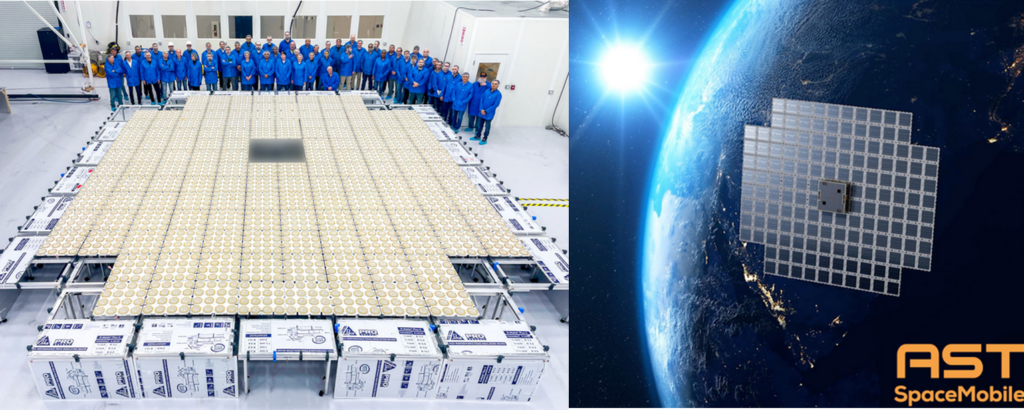
To hear the faint signal from the tiny antenna in your phone 300 miles away, the satellite needs a gigantic ear. When you imagine a 2400 square foot metal structure silently unfolding in Earth orbit, the first image that comes to mind is a Star Destroyer from Star Wars. But this is not the Galactic Empire, it is pure terrestrial engineering.
The new second generation commercial satellites (like the BlueBird 6 from AST SpaceMobile) do not use old parabolic dish antennas. They open a structure in space called a Phased Array. It is the largest commercial communication panel ever assembled in orbit.
This massive structure does not throw the signal everywhere. The Phased Array system uses a technique called Beamforming to create thousands of spot beams or highly focused coverage cells on the ground.
Surgical Cell Control and Disaster Response
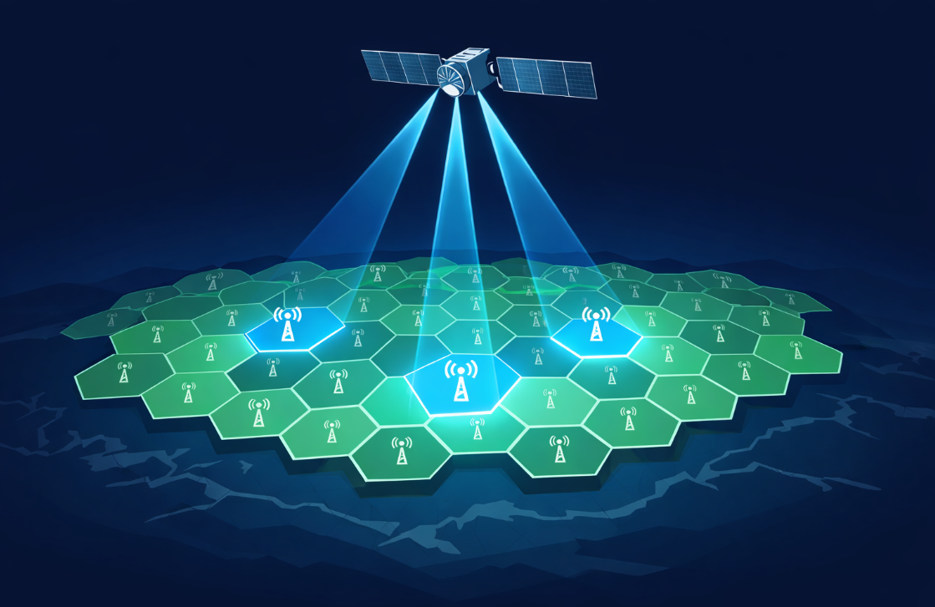
The fact that coverage is divided into thousands of individually controlled cells solves the biggest problem for carriers: interference.
On normal days, engineers simply turn off the satellite cells that would pass over major metropolises like New York or Los Angeles. This ensures the satellite does not interfere with terrestrial towers that are already working perfectly.
However, this switch can be flipped in seconds. We saw this happen in practice during the passage of the devastating Hurricanes Helene and Milton through the southeastern United States. With the terrestrial fiber and cell tower infrastructure completely destroyed in Florida and North Carolina, the FCC granted emergency authorizations. The companies surgically turned on their satellite spot beams only over the disaster zones. Isolated people were able to receive government evacuation alerts and send vital SMS messages to rescue teams. It was the definitive proof that the network works.
Latency and Bandwidth: The End of the Achilles Heel
If you have ever used legacy satellite internet (those geostationary systems 22,000 miles away), you know the Achilles heel has always been latency. The signal took so long to travel back and forth (over 600 milliseconds) that any voice call sounded like an amateur radio with a delay.
The new network solves this by operating in Low Earth Orbit. At this distance, physics allows the latency to drop to the 20 to 40 milliseconds range. That is fast enough for audio streaming, video calls, and smooth browsing.
Massive traffic can be a challenge if thousands of people try to download 4K videos at the same time in a single space cell. That is why network engineering implements strict Quality of Service (QoS). Under normal circumstances, traffic is balanced for text messages and light data. However, for public safety platforms (like FirstNet), QoS guarantees absolute priority, ensuring rescue teams have dedicated broadband even if the cell is congested.
The Space Race Roadmap
To understand who is dominating this infrastructure, I put together a technical table of how the main US carriers are positioning themselves:
| Terrestrial Carrier | Space Partner | Initial Focus | National Deployment Target (US) |
| AT&T / FirstNet | AST SpaceMobile | Voice, 5G Data and Rescue Broadband | 2025 (Phase 1) to 2026 (National) |
| Verizon | AST SpaceMobile | Voice, Data and Messaging (Standard Phones) | 2025 (Phase 1) to 2026 (National) |
| T Mobile | SpaceX (Starlink) | SMS Messaging (Initial) / Voice and Data (Future) | Active Testing; Expanding in 2025/2026 |
| Apple (Hardware) | Globalstar | Emergency SOS via Satellite | Active (Expanding to standard SMS) |
How Direct to Cell Compares to Residential Satellite Internet?
It is common to confuse this new technology with residential satellite internet services (like the Starlink dish you put on your roof). Although both use low earth orbit, the network architecture and hardware are completely different. Here is the engineering breakdown:
| Feature | Residential Internet (e.g. Starlink Dish) | Space Cellular (Direct to Cell / AST SpaceMobile) |
| User Hardware | Phased Array Dish and Router | Standard Smartphone (Any current 4G/5G model) |
| Frequency Bands | Ku, Ka and V Bands (Space Spectrum) | Terrestrial Cellular Spectrum (UHF, LTE, 5G) |
| Satellite Antenna | Moderate size | Giant Panels (Phased Arrays over 2400 sq ft) |
| Mobility | Fixed or vehicle mounted with clear sky view | Extremely High (Works in your pocket, walking, anywhere) |
| Bandwidth | Very High (100 to 200+ Mbps per home) | Moderate (Focused on covering dead zones with QoS) |
The Reality Check: The Catch That Physics Does Not Forgive
If you read the press releases from Verizon or T Mobile, it sounds like all your problems are solved. But as network engineers, we know there is no free lunch in physics. There are two major practical limitations you need to know before you think about using satellite connectivity indoors.
1. The Indoor Problem (Line of Sight)
The golden rule of radio frequency still applies: the greater the distance, the greater the signal attenuation. The 2400 square foot Phased Array in space can send the signal to the ground, but that signal arrives weak. It is more than enough if you are standing in a pasture or on top of a mountain (with a clear Line of Sight to the sky). However, that signal will not penetrate your concrete roof, a dense forest canopy, or the thermal glass of your car. This technology is strictly outdoor. If you are trapped in a cabin in the snow, you will have to step outside in the cold to send an SOS text.
2. Battery Consumption (Screaming into Space)
Your phone was not designed to transmit into space. Its transmitter is weak (limited by the FCC to a fraction of a Watt so it does not fry your brain). To get a data packet back to a satellite 300 miles up, your smartphone modem will operate at the maximum transmission power allowed by the hardware. The satellite does the heavy lifting, but in marginal areas, trying to maintain a satellite data connection will drain your battery significantly faster than being connected to the tower down the street. In an emergency, manage your power.
The Engineering Verdict
What we are witnessing is not just a signal upgrade, it is a rewrite of the telecommunications network architecture. The ability to use satellites the size of a tennis court as invisible backups for our standard smartphones proves that the barrier between space and terrestrial networks has finally disappeared.
The infrastructure is being launched into space as you read this article. Soon, the No Service message will be just a memory of the past.
Technical Sources and References:
- FCC Public Filings: Documentation on the Supplemental Coverage from Space (SCS) framework for terrestrial frequency use.
- AST SpaceMobile Technology: LEO latency specifications and QoS architecture for emergency services.
- IEEE Communications Society: Analysis on the convergence of non-terrestrial networks (NTN) and 3GPP protocols for 5G.
- FirstNet Authority: Network integration for public safety and prioritization of mission-critical satellite traffic.